1. Build a Greenhouse or Cold Frame
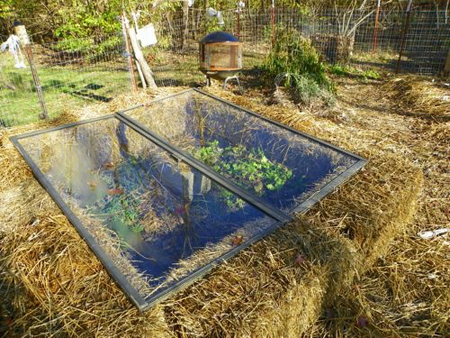 |
| Photo by A Larrapin Garden |
A cold frame is basically a mini-greenhouse comprising a horizontal or slightly tilted glass cover over a box or raised garden bed. The simplest design I've seen is plopping an old glass door over a straw-bale frame.
2. Build a Solar Water Heater
The are two methods of passive solar water heating. The first is to have a shallow box with black tubing snaked through it. In the sun, the water heats up as the water moves through, then is stored in an insulated tank.
The second way is like the video below: You actually have the water tank within the box, heating up. This method will work well in South Texas, where the cooling of the tank at night isn't much of an issue. But it probably isn't a good idea in areas with frigid nights.
3. Build a Solar Food Dryer
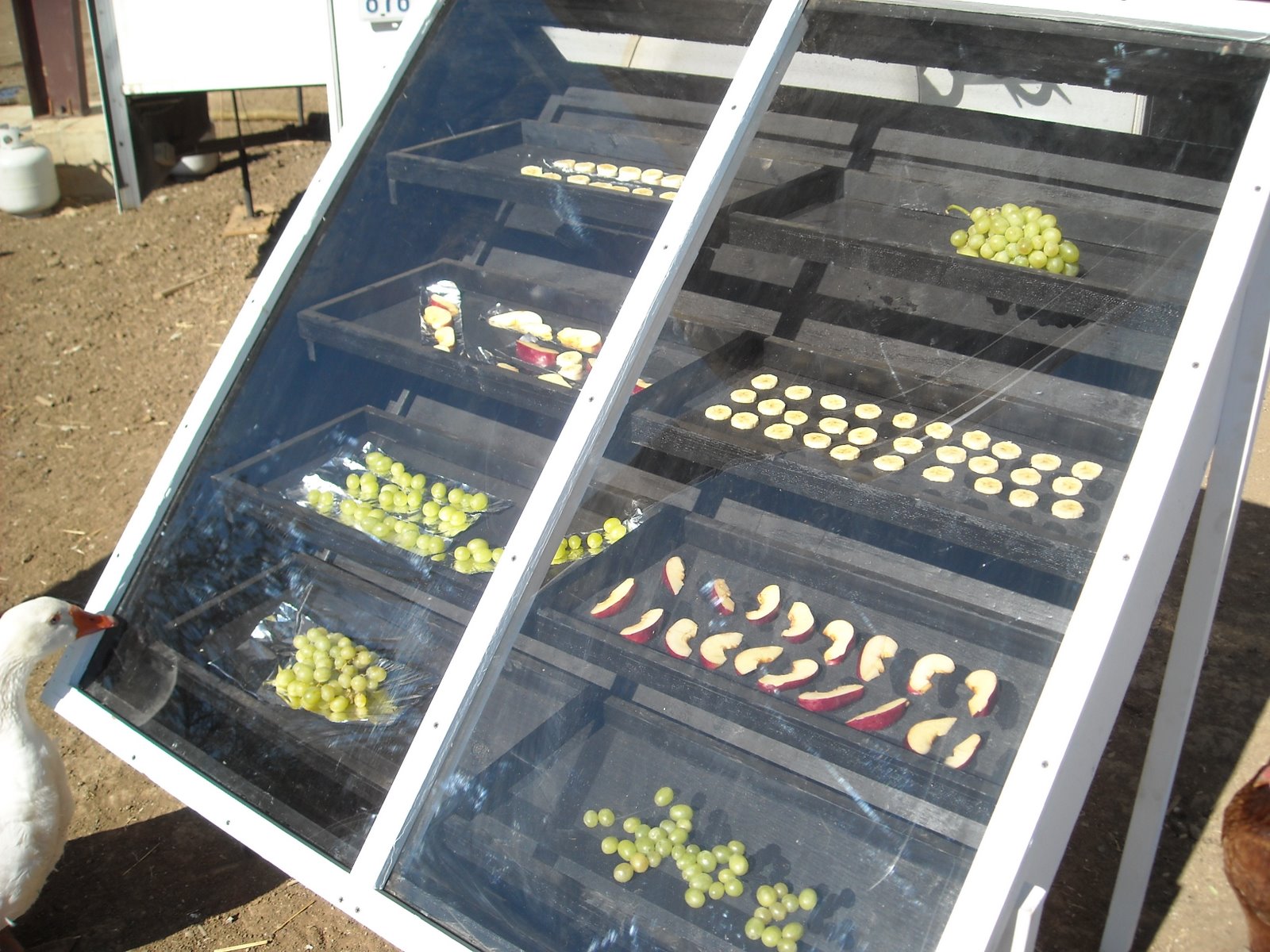 |
| Solar food dryer photo by David and Susan Sifford. |
I like these plans from North Dakota State University.
If I used the sliding doors, I'm not sure if I'd modify the plan to keep the panes in the sliding frame or pull them out and add them to a static frame connected to the box by hinges.
4. Build a HUGE Solar Oven
 |
| Solar box cooker from fridge. Photo by Matt West. |
 |
| "Minimum" solar box cooker |
But I just had a thought! Maybe I could make the solar food dryer with insulated sides, and then add a detachable or separate reflector, similar to the "minimum solar box cooker" at right, when I want to concentrate the suns rays to cook instead of merely dry. Then I'd have a two-in-one device! Hmm ...
5. Build an Absorption Chiller

South Texas subtropical "summers" (most of the year!) are hot, hot, hot and sticky. And with Global Warming, we could be facing more summer heat waves over 100 ºF (38 ºC) in the future. Keeping food and people cool is significant to comfort and even survival. Sometimes, sitting in the shade just doesn't cut it.
But I've learned that passive solar heat can be used to chill air, even create ice. The device is called an "absorption chiller" or "absorption refrigerator," and converts heat to cold through a clever interaction of state changes between different liquids. The great thing is that these units can be made with no moving parts, and so they'll last longer and be more reliable if service and parts supply chains fail.
The downside to absorption chillers when compared to regular refrigeration is that they are less energy efficient. But that only matters when you're talking about adding heat using fuel or electricity. Since this would use solar, there is no waste, and we can afford to be less efficient. Even so, advanced, sophisticated designs can be efficient enough to produce ice!
Another downside is that I can find no plans to actually build one. I suspect that while the theory is easy enough to explain, the details of how to build one – how much of what liquid to use, how long and strong to make tubing, etc. – requires advanced engineering and physics knowledge. Damnit, Jim, I'm an English major, not an engineer!
As far as the sliding doors, I'd use them for the heat collector box to fuel the cycle, much like in the dryers and ovens above.
6. Build a Glass-Front Cabinet or Closet
 |
| Photo by James Merrel. |
Alternatively, you could remove the panes from the door and use them in separate, hinged door frames.
7. Install a Sliding Shower Door
According to This Old House, "The standard bathtub is 5 feet long x 30 to 32 inches wide." My sliding door is 4.33 ft. (52 in.), and likely a few inches longer with now-hidden parts of the frame. I looked quickly online to see if someone has done this, but I couldn't find any posts. It should be possible, but I'm no handyman. I think the key factors are going to be whether there is enough room outside the door to build a mounting frame, whether the tub can support the door weight, and whether the frame, joints and door can be adequately sealed against moisture.
In my case, my shower/tub is a single fiberclass unit, which will prevent mounting the door. At my house, using my door for the shower is a "no go."
8. Build Homemade Solar Panels
This fellow made his own 22 V solar panel using a sliding glass door, photovoltaic units and beer packaging.
I used an older sliding glass door to build this panel. It came apart pretty easy. The glass is tempered so it wont break real easy. After soldering all the tabs down I used old beer banners to give the white back. Then I used some cardboard to fill space in the back. Sealed the inside with silicone and put it back together.
9. Sell or Trade It
Old sliding glass doors must have value to someone. I could try to sell it on Craigslist or by calling some contacts. Maybe someone is willing to do a trade instead of a cash transaction. Hmm ... Gonna have to think on this one.
10. Freecycle It
In hipper parts of the country, I could advertise it on Freecycle.org, but that site isn't really used in the Rio Grande Valley. Craigslist is always an option. But probably the easiest way to freecycle the door is putting it out on the curb. Experience tells me someone will haul it off for reuse. Maybe I could even donate it to Habitat for Humanity for a tax deduction.
#recycling #solar #passivesolar #designs

Good read, It really is incredibly fantastic and informative website. Good to discover your site Very well article! keep sharing.
ReplyDelete